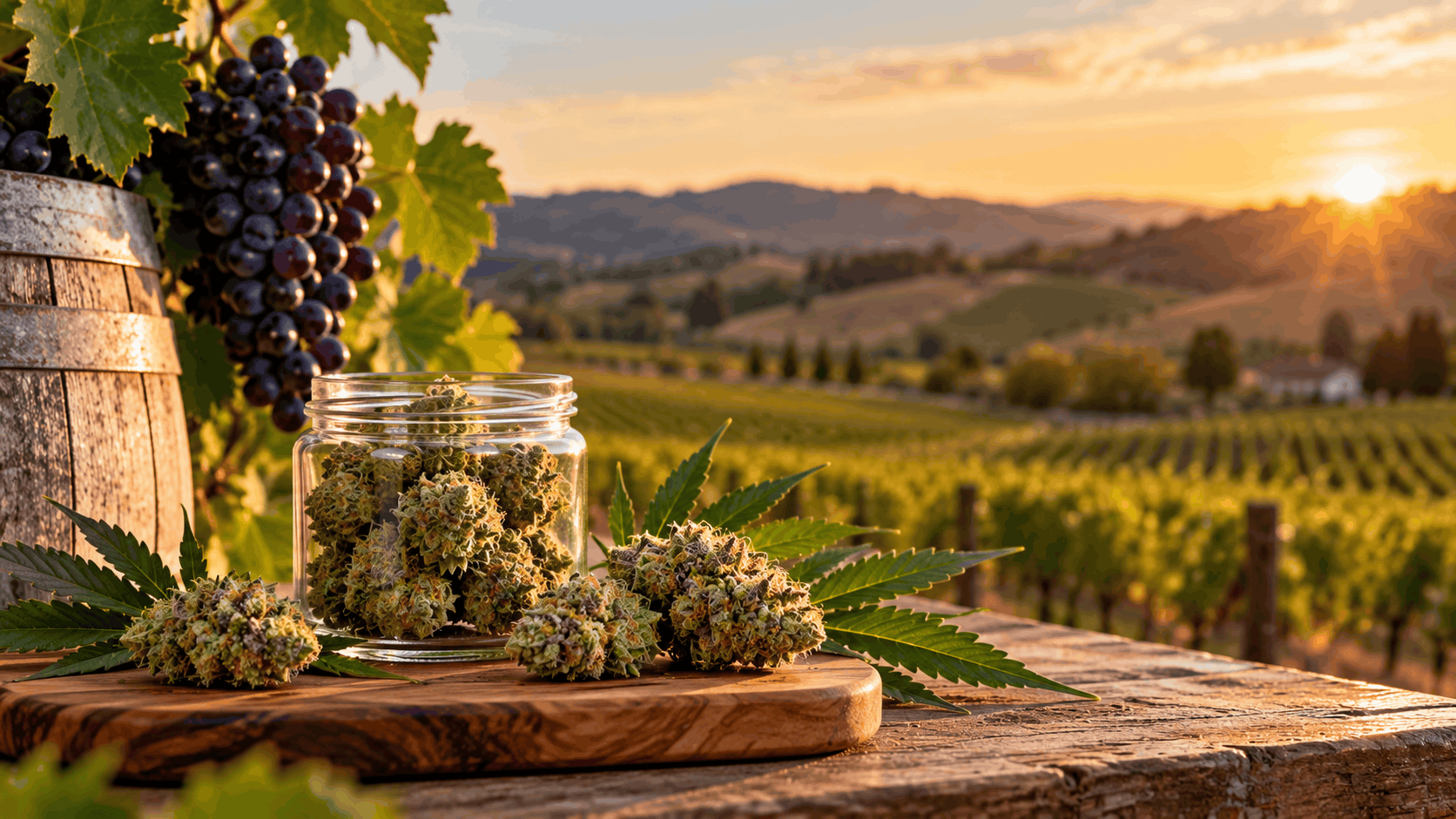
Sonoma County cannabis has something mass-produced flower cannot easily replicate: a strong connection to place. Climate, sun exposure, soil, cultivar choice, cultivation methods, harvest timing, drying, and curing can all influence the final character of cannabis.
That does not mean every locally grown product is automatically better than every large-scale product. Quality still depends on the cultivator, genetics, post-harvest handling, testing, freshness, and storage.
But for shoppers who care about aroma, flavor, provenance, and how a product was grown, Wine Country cannabis offers a useful way to think beyond THC percentage alone.
Quick Takeaways
-
Cannabis terroir describes how place, environment, genetics, and cultivation practices can contribute to the character of cannabis.
-
Sonoma County's agricultural identity makes provenance especially relevant to local cannabis shoppers.
-
Small-batch production may allow closer attention to harvest timing, drying, curing, and individual cultivars, but small scale alone does not guarantee quality.
-
THC percentage is only one part of evaluating flower; terpene profile, freshness, aroma, testing, and storage also matter.
-
California is developing a formal Cannabis Appellations Program, but as of October 2026, the program is not yet accepting appellation petitions.
What Does Cannabis Terroir Mean?
The word terroir is most closely associated with wine.
In viticulture, it describes how characteristics of a place, including climate, soil, elevation, exposure, agricultural methods, and local tradition can influence an agricultural product.
The same basic concept is increasingly being applied to cannabis.
Cannabis terroir can involve factors such as:
-
Local climate
-
Temperature changes between day and night
-
Sun exposure
-
Humidity
-
Soil characteristics
-
Elevation
-
Water conditions
-
Cultivar or genetics
-
Cultivation methods
-
Harvest timing
-
Drying and curing practices
The result is not as simple as saying, “this soil produces this terpene.”
Cannabis chemistry is influenced by genetics and cultivation conditions together, while drying, curing, storage, and handling can alter what consumers ultimately smell and experience.
That is why terroir should be viewed as a combination of place and production, not a guarantee of quality based only on ZIP code.
For a deeper look at the relationship between regional identity and cannabis, see The Sweet Spot's guide to cannabis appellations in California.
Why Sonoma County Is a Natural Place to Talk About Terroir
Sonoma County already has a strong agricultural identity.
Wine consumers are accustomed to thinking about:
-
Where grapes were grown
-
The climate of a vineyard
-
Regional growing conditions
-
Vintage
-
Farming methods
-
Individual producers
Sonoma County's mapping data includes established American Viticultural Areas used in the wine industry, reflecting how deeply geographical origin is connected with the region's agricultural identity.
Cannabis allows consumers to ask similar questions.
Instead of choosing flower only because the package shows a high THC number, a shopper can consider:
-
Who cultivated it?
-
Where was it grown?
-
Was it indoor, mixed-light, or outdoor?
-
How fresh is the batch?
-
What does it smell like?
-
Which terpenes are present?
-
How was it dried and cured?
-
What does the lab report show?
This is one reason the comparison between cannabis and wine in Sonoma County is more than a marketing analogy. Both are agricultural products where origin, production, and sensory characteristics can matter to consumers.
What Is the California Cannabis Terroir Concept?
The idea of California cannabis terroir is becoming more formal through California's Cannabis Appellations Program.
The California Department of Food and Agriculture describes an appellation of origin as a protected designation that identifies geographical origin and can include production requirements.
According to CDFA, the program is intended to help protect place-based cultivation, prevent misleading origin claims, and allow regions to define characteristics involving environment, cultivation practices, history, and cultivars.
The program is specifically designed for qualifying licensed outdoor cultivators. Current rules require mature flowering plants associated with the program to be cultivated outdoors, in the ground, without artificial light or structures covering the canopy.
Important 2026 status
As of October 2026, CDFA says the Cannabis Appellations Program is not currently accepting petitions and anticipates opening the program after remaining regulatory work is finalized.
That distinction matters.
A cannabis product being grown in Sonoma County does not automatically mean it has an official California appellation.
California regulations also restrict misleading geographic and appellation claims on cannabis labeling.
So consumers should distinguish between:
Locally grown cannabis
and
a formally recognized appellation designation
They are not necessarily the same thing.
Craft Cannabis vs. Mass-Produced Cannabis
The phrase "mass-produced weed" can sound automatically negative, but scale itself does not determine quality.
Large producers can grow excellent cannabis. Small farms can produce disappointing flower.
The real difference is often how easily a producer can maintain attention to individual batches.
|
Quality Factor |
Craft / Small-Batch Approach |
Large-Scale Production |
|
Batch attention |
Often highly individualized |
More standardized |
|
Cultivar selection |
May emphasize distinctive genetics |
Often prioritizes consistency and demand |
|
Harvest timing |
Can be adjusted by individual cultivar |
May follow broader production schedules |
|
Drying and curing |
Potential for close batch monitoring |
Often standardized for volume |
|
Consistency |
Can vary from batch to batch |
Often a major operational priority |
|
Provenance |
May be central to the product story |
May be less prominent |
|
Availability |
More limited |
Usually broader |
|
Quality guarantee |
No |
No |
The point is not that one model always wins.
For consumers seeking premium cannabis Sonoma County products, the advantage of smaller, place-focused production is often the opportunity to evaluate cannabis as an agricultural product rather than simply as a standardized THC delivery format.
Terpenes: Where Terroir Becomes Sensory
Open a container of quality flower and aroma is often the first thing you notice.
Citrus.
Pine.
Earth.
Floral notes.
Fuel.
Fruit.
Pepper.
Those aromas are influenced in part by volatile compounds, including terpenes.
Common cannabis terpenes include:
-
Myrcene
-
Limonene
-
Pinene
-
Linalool
-
Beta-caryophyllene
-
Terpinolene
Terpenes should not be treated as a simple formula that predicts exactly how a product will make someone feel. However, they are useful for describing aroma and flavor differences between cultivars and batches.
If you want to compare those sensory characteristics more systematically, The Sweet Spot's cannabis flavor wheel provides a practical framework for describing what you smell and taste.
That is a more nuanced way to evaluate flower than simply asking:
What's the highest THC percentage?
Why THC Percentage Does Not Tell the Whole Story
THC content is useful information, but it is not a complete measure of flower quality.
Consider two products:
Flower A
-
31% total THC
-
Weak aroma
-
Dry texture
-
Older harvest
-
Poor storage
Flower B
-
23% total THC
-
Strong aroma
-
Fresh structure
-
Recent batch
-
Carefully cured
The higher THC number does not automatically make Flower A the better product.
Consumers evaluating flower should also consider:
-
Freshness
-
Aroma
-
Moisture and texture
-
Terpene profile
-
Cultivar
-
Harvest or packaging date
-
Producer reputation
-
Testing information
-
Storage conditions
The Sweet Spot's guide to premium cannabis product quality explores how quality evaluation is moving beyond potency alone.
The COA Adds Another Layer of Transparency
For licensed California cannabis, laboratory testing provides information consumers cannot determine by appearance or smell alone.
A Certificate of Analysis, or COA, can contain information about:
-
Cannabinoid content
-
THC and THCa
-
CBD and other cannabinoids
-
Tested contaminants
-
Batch information
-
Laboratory results
The COA does not tell you whether you will personally enjoy a product's flavor or aroma.
But it adds objective testing information to the buying decision.
If you are unfamiliar with laboratory reports, use The Sweet Spot's guide on how to read a California cannabis COA before relying only on the potency number printed on a package.
Freshness Matters as Much as Origin
Even excellent cannabis can lose quality after harvest if it is handled poorly.
Over time, flower can lose:
-
Aroma
-
Moisture
-
Terpene intensity
-
Texture
-
Overall sensory quality
Exposure to excessive light, heat, oxygen, or poor storage conditions can accelerate deterioration.
That means terroir does not stop mattering at harvest—but neither does it protect cannabis from poor post-harvest handling.
The chain looks more like:
Genetics → Growing Environment → Cultivation → Harvest → Drying → Curing → Packaging → Storage → Consumer
Weak handling at any stage can reduce the quality of the final experience.
For home storage after purchase, see The Sweet Spot's guide to storing cannabis flower and edibles.
How Can You Shop for Better Sonoma County Cannabis?
You do not need to become a cultivator or chemist.
Use a simple checklist.
1. Look Beyond THC
Do not automatically choose the largest number on the label.
Consider the whole product.
2. Check the Producer
Learn who cultivated the flower and where it came from when that information is available.
3. Examine Freshness
Look at package or harvest information where provided.
4. Consider Aroma
A strong, characteristic aroma can tell you more about the sensory quality of the flower than THC percentage alone.
5. Review the COA
Confirm that testing information matches the product and batch.
6. Ask About Cultivation
If provenance matters to you, ask whether the flower was:
-
Outdoor
-
Indoor
-
Mixed-light
No method is automatically superior. They produce different environments and production goals.
7. Buy From a Licensed Retailer
Licensed dispensaries give consumers access to regulated cannabis products with required testing and labeling.
For local shoppers comparing stores, The Sweet Spot's guide to choosing a dispensary in Santa Rosa covers additional factors to consider.
Does "Local" Automatically Mean Better?
No.
Local origin is useful information, not proof of quality.
A locally cultivated product can still be:
-
Poorly dried
-
Improperly cured
-
Old
-
Badly stored
-
Unappealing to your personal taste
Similarly, a large producer can maintain excellent cultivation and post-harvest standards.
The better question is:
Does the product combine strong cultivation, transparent provenance, good testing, freshness, careful handling, and sensory quality?
That framework is much more useful than assuming "local = premium" or "large-scale = bad."
Why Wine Country Cannabis Still Has a Real Advantage
The strongest advantage of Wine Country cannabis is not that Sonoma soil magically guarantees better flower.
It is the regional culture of treating agricultural origin as meaningful.
Consumers in wine country already understand ideas such as:
-
Place
-
Producer
-
Batch variation
-
Aroma
-
Craft
-
Harvest
-
Provenance
Those same ideas create a richer way to evaluate cannabis.
Instead of reducing flower to one THC percentage, consumers can ask where it was grown, how it was cultivated, what it smells like, how fresh it is, and whether the producer has a reputation for quality.
That is the real cannabis terroir advantage.
What Cannabis Appellations Could Mean for Sonoma County
California's emerging appellation system could eventually give consumers clearer ways to identify cannabis tied to defined growing areas and cultivation practices.
CDFA says the purpose of its Cannabis Appellations Program includes protecting regional identity, preventing misrepresentation of origin, and helping consumers understand where and how qualifying cannabis was produced.
For Sonoma County, that model is especially familiar because regional agricultural identity already plays such a visible role in wine.
But consumers should be careful not to get ahead of the regulatory process.
Until formal appellations are established, terms such as "Sonoma-grown," "craft," "small-batch," and "terroir" should be evaluated based on actual product information rather than assumed certification.
California cannabis rules also interact with local regulations, so shoppers interested in the broader regulatory picture can review The Sweet Spot's guide to Sonoma County cannabis laws.
FAQ
What is cannabis terroir?
Cannabis terroir describes how geography, climate, cultivation practices, genetics, soil, and other environmental factors may contribute to the character of cannabis grown in a particular place.
What makes Sonoma County cannabis different?
Sonoma County has a strong agricultural culture and varied growing conditions. For consumers, the main opportunity is access to cannabis that may emphasize provenance, cultivator identity, freshness, aroma, and craft production rather than THC percentage alone.
Is Sonoma County cannabis automatically higher quality?
No. Geographic origin alone does not guarantee quality. Genetics, cultivation, drying, curing, testing, storage, and freshness all influence the final product.
What is California cannabis terroir?
California cannabis terroir refers broadly to the relationship between cannabis and its growing environment. California is also developing a formal Cannabis Appellations Program that will establish protected geographical designations for qualifying outdoor cultivation. The program is not yet accepting petitions as of October 2026.
Is craft cannabis better than mass-produced cannabis?
Not automatically. Craft production may allow closer attention to individual batches and cultivars, while large producers may deliver greater consistency. Quality should be judged product by product.
How can I identify premium cannabis Sonoma County products?
Look at producer information, freshness, aroma, cultivar, cannabinoid and terpene data where available, the COA, storage quality, and the reputation of the licensed retailer carrying the product.
Final Thoughts
The biggest advantage of Sonoma County cannabis is not simply that it comes from Wine Country. It is the opportunity to think about cannabis as an agricultural product shaped by genetics, place, cultivation, harvest, curing, testing, and freshness.
The best flower is not automatically the product with the highest THC percentage or the smallest production run. Quality comes from the entire process.
For adults 21+ exploring cannabis in Santa Rosa and Sonoma County, The Sweet Spot offers a broad selection of licensed cannabis products along with knowledgeable staff who can help shoppers compare flower, cultivars, product formats, lab information, and other quality factors without reducing the decision to potency alone.