
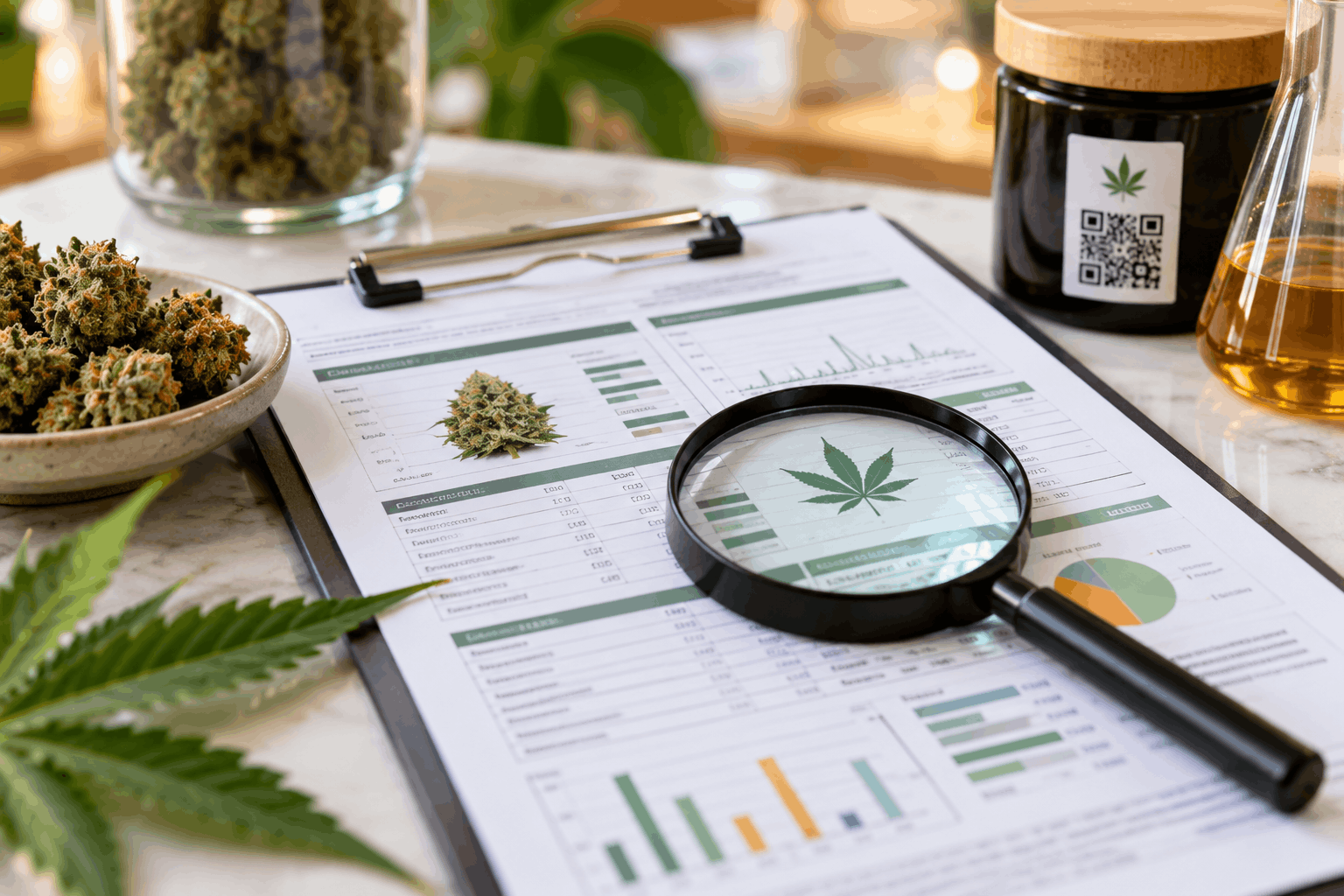
A California cannabis COA is a laboratory report showing a product batch’s cannabinoid potency and regulatory testing results. To understand one, match the batch information, verify the testing laboratory, review Total THC, check the safety panels, and confirm the sample passed applicable California requirements.
Learning how to read a cannabis COA can help California shoppers understand what is actually inside a cannabis product instead of relying only on package claims. A Certificate of Analysis includes information about cannabinoids, testing dates, batch identity, laboratory details, and regulatory safety results.
Quick Takeaways
-
A California cannabis COA should correspond to the exact product batch you are buying.
-
Check THCa, delta-9 THC, CBD, and Total THC rather than relying on one potency number.
-
Review pesticide, heavy-metal, microbial, mycotoxin, solvent, and other applicable safety results.
-
A cannabis COA QR code can make reports easier to access, but the report still needs to match the product.
What Is a COA in Cannabis?
If you are asking what a COA is that cannabis shoppers receive, COA stands for Certificate of Analysis.
It is a laboratory document showing the results of tests performed on a sample from a cannabis batch. In California, licensed cannabis products undergo regulatory testing before they can be released for retail sale.
A COA can include:
-
Product and batch identification
-
Laboratory information
-
Test and certificate dates
-
THC and other cannabinoid results
-
Terpene information where reported
-
Pesticide results
-
Heavy metals
-
Residual solvents
-
Microbial contaminants
-
Mycotoxins
-
Water activity or moisture results
-
Overall pass or fail status
California cannabis testing laboratories must meet applicable state licensing and accreditation requirements.
Step 1: Check the California Cannabis COA Header
When learning how to read a certificate of analysis, start with the identifying information rather than the THC percentage.
Check:
Product and batch number
The product name and batch or production number on the California cannabis COA should correspond with the product package. If you also want help understanding the information printed directly on the package, our cannabis label guide for THC, CBD, terpenes, and serving size explains how to read the most important consumer-facing label details.
If they do not match, ask the retailer or manufacturer for the correct report.
Sample ID
A laboratory sample ID identifies the specific sample submitted for testing. It may be different from the larger production or harvest batch number.
UID or tracking information
California cannabis products move through the regulated track-and-trace system. Where a UID appears on the report and packaging, compare the information.
Laboratory information
Look for:
-
Laboratory name
-
California license information
-
Contact details
-
Accreditation information where provided
Testing date
The date tells you when the sample was analyzed. An unusually old test date is worth asking about, especially when evaluating older inventory.
Step 2: Understand THCa, THC and Total THC
One of the most important parts of how to read a cannabis COA is understanding that THCa and delta-9 THC are not the same number.
THCa is the acidic precursor to THC. When cannabis is heated, some THCa converts into delta-9 THC through decarboxylation.
A commonly used Total THC calculation is:
Total THC = Delta-9 THC + (THCa × 0.877)
For example, if a COA shows:
-
THCa: 28%
-
Delta-9 THC: 1.2%
Then:
28 × 0.877 = 24.56
24.56 + 1.2 = approximately 25.76% Total THC
This is why simply adding THCa and THC percentages together would overstate the potential Total THC.
What Other Cannabinoids May Appear?
A California cannabis COA may also list:
-
CBD: A non-intoxicating cannabinoid found in some cannabis products.
-
CBG: A minor cannabinoid that can appear in different concentrations.
-
CBN: A cannabinoid that may increase as THC oxidizes over time.
-
THCV: Another naturally occurring cannabinoid sometimes included in detailed reports.
For a simpler breakdown of how the two most familiar cannabinoids differ, see our guide to THC vs CBD. Do not assume that any one cannabinoid guarantees a particular experience. Product type, dosage, tolerance, terpene profile, and individual response all matter.
Step 3: Read the Terpene Profile
Terpenes are aromatic compounds that contribute to the smell and flavor of cannabis.
Common examples include:
|
Terpene |
Common Aroma |
|
Myrcene |
Earthy, herbal, musky |
|
Limonene |
Citrus, lemon |
|
Caryophyllene |
Peppery, spicy, woody |
|
Linalool |
Floral, lavender |
If you want to connect lab-reported terpene data with real-world aroma and flavor descriptions, our cannabis flavor wheel can help you compare common sensory profiles. Terpene levels may be reported as percentages, mg/g, or another concentration unit depending on the laboratory.
Use terpene information mainly to understand and compare aroma and flavor profiles. Avoid assuming a terpene automatically guarantees a particular physical or psychological effect.
Step 4: Check DCC Regulatory Compliance Testing
The safety section is one of the most important parts of a COA. Testing standards and product transparency continue to evolve, so shoppers interested in how lab reporting may change can also read our guide to the future of cannabis testing and product transparency.
DCC regulatory compliance testing can include several contaminant and quality categories depending on the product.
Pesticides
The report should indicate whether regulated pesticide levels met applicable California requirements.
Residual solvents
Extracted or manufactured cannabis products may be tested for solvents associated with production processes.
Heavy metals
California cannabis testing includes regulated metals such as:
-
Lead
-
Arsenic
-
Cadmium
-
Mercury
Microbial impurities
Testing can include harmful microorganisms such as Salmonella, certain E. coli, and specified Aspergillus species depending on the product category.
Mycotoxins
Labs also screen for certain toxic compounds produced by fungi, including regulated aflatoxins and ochratoxin A.
Water activity and foreign material
Water activity can help assess whether enough available moisture is present to support microbial growth. Regulatory testing can also examine products for unacceptable foreign material.
What Do ND, LOD and LOQ Mean?
These abbreviations commonly appear on cannabis lab reports.
ND — Not Detected:
The substance was not detected at or above the laboratory's applicable reporting threshold.
LOD — Limit of Detection:
The lowest amount the laboratory can reliably distinguish from its absence.
LOQ — Limit of Quantitation:
The lowest amount the laboratory can reliably measure and report as a numerical concentration.
Importantly, ND does not always mean absolute zero. It generally means the analyte was not detected at the method's reporting level.
What Does Pass or Fail Mean?
A Pass means the tested sample met the applicable regulatory requirement for that test.
A Fail means it did not meet the applicable requirement.
When reviewing a COA, pay particular attention to the overall regulatory status and individual safety panels.
A failed batch cannot simply be treated the same as a batch that has passed regulatory testing.
How Do You Check a Cannabis COA QR Code?
Some California cannabis products include a cannabis COA QR code that gives shoppers quick access to laboratory results.
After scanning it, check:
-
Does it open a real COA?
-
Does the product name match?
-
Does the batch number match?
-
Is the laboratory clearly identified?
-
Is the test date shown?
-
Does the report include regulatory testing results?
-
Did the required tests pass?
A QR code alone does not prove that the report belongs to the product in your hand.
The most important check is still the batch match.
How Can You Spot a Suspicious COA?
Watch for:
-
Batch numbers that do not match the package
-
Missing laboratory information
-
Missing test dates
-
Cropped or incomplete laboratory reports
-
Conflicting product details
-
Missing regulatory testing information
-
A QR code that opens the wrong product or batch
-
Potency values that appear unusually high and cannot be verified
An unusual potency number is not automatically proof of fraud. Verify the full report, laboratory, batch information, and Total THC calculation before concluding.
How to Read a California Cannabis COA in 60 Seconds
If you want a fast process, use this checklist:
-
Match the product and batch.
-
Verify the testing laboratory.
-
Check the test date.
-
Confirm the regulatory pass status.
-
Review THCa and delta-9 THC.
-
Check Total THC math.
-
Review terpene data if available.
-
Confirm applicable safety tests passed.
For most shoppers, these eight checks provide enough information to decide whether the COA matches the product and understand the most important laboratory results.
Frequently Asked Questions
Where can I find a California cannabis COA?
Some products provide a QR code or testing URL. You may also be able to obtain the report from the dispensary, manufacturer, brand, or testing laboratory.
What is the difference between THCa and delta-9 THC?
THCa is the acidic precursor to THC. Heat can convert THCa into delta-9 THC through decarboxylation.
What does ND mean on a cannabis COA?
ND means Not Detected at the laboratory's applicable detection or reporting level. It does not necessarily mean the substance is mathematically zero.
Is a cannabis COA QR code required to prove a product is legitimate?
No. A QR code can make testing information easier to access, but it is not proof by itself. The report should still match the product and batch.
What happens if a California cannabis batch fails testing?
A failed batch cannot simply proceed through retail distribution as though it passed. Depending on the applicable rules and failure type, additional regulatory steps such as remediation, retesting, or destruction may be required.
Final Takeaway
Learning how to read a cannabis COA helps you look beyond marketing claims and understand the laboratory data behind a California cannabis product.
Start by confirming that the California cannabis COA matches the product and batch. Then check the laboratory, test date, Total THC calculation, cannabinoid profile, and DCC regulatory compliance testing results.
California rules also interact with local requirements, so Sonoma County shoppers can review our guide to Sonoma County cannabis laws for additional local context.
If a cannabis COA QR code is provided, use it as a convenient way to access the report, but always confirm that the laboratory document corresponds to the exact product you are considering.