
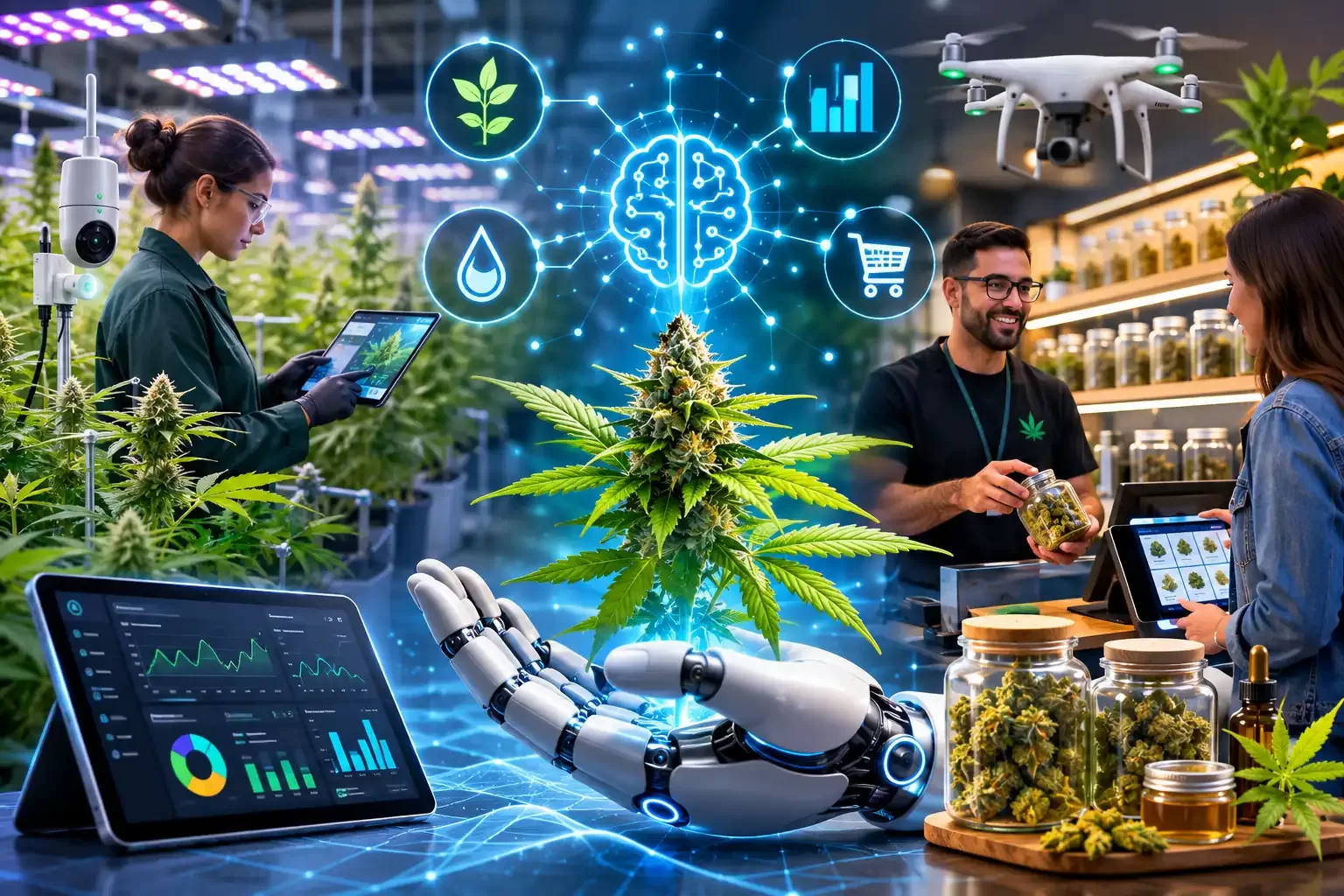
Running a cannabis business in the United States has become more demanding than ever. Operators must manage rising labor costs, changing state regulations, inventory accuracy, and customer expectations while protecting profit margins. Every cultivation facility and retail location produces valuable operational data, yet many businesses still rely on manual processes that limit efficiency and increase the risk of costly mistakes.
AI in Cannabis is helping businesses transform this information into practical insights. Instead of spending hours reviewing spreadsheets or manually checking environmental conditions, operators can use intelligent software to identify patterns, predict outcomes, and recommend actions before problems become expensive.
Modern cultivation facilities use connected sensors, environmental controls, and cultivation software to monitor plant health throughout the growing cycle. Retail teams use predictive analytics to improve inventory planning, personalize customer recommendations, and better understand purchasing behavior. Compliance teams use intelligent systems to compare records across METRC, BioTrack, laboratory reports, and POS systems, reducing manual reconciliation work.
Rather than replacing experienced growers or retail professionals, artificial intelligence supports faster and more informed decision making. Businesses that combine skilled employees with reliable technology often achieve greater operational consistency while reducing unnecessary costs.
This article explains how AI in Cannabis supports cultivation, Smart Farming, Retail Technology, and Automation while helping operators build stronger, more efficient businesses.
Key Takeaways
-
AI in Cannabis helps operators improve cultivation, compliance, inventory planning, and customer service through data driven decisions.
-
Smart Farming combines sensors, environmental monitoring, and Automation to improve crop consistency while reducing water and energy use.
-
Retail Technology helps dispensaries forecast demand, personalize recommendations, and recover missed sales opportunities.
-
Successful AI adoption begins with accurate operational data, trusted software, and trained staff who maintain oversight of compliance decisions.
What is AI in Cannabis and Why Does It Matter Today?
AI in Cannabis uses machine learning, predictive analytics, computer vision, and connected software to analyze cultivation, inventory, sales, and compliance data. These insights help operators improve production, reduce waste, maintain regulatory compliance, and make faster business decisions based on measurable operational information.
Artificial intelligence refers to computer systems that learn from large amounts of data and identify patterns that people may overlook. Within the cannabis industry, AI processes information from cultivation facilities, retail operations, laboratory testing, and supply chain systems to support daily business decisions.
Every cannabis business generates thousands of data points each day. Environmental sensors record temperature, humidity, carbon dioxide levels, and lighting performance. POS systems collect purchasing trends and customer preferences. Compliance platforms such as METRC and BioTrack track products throughout the seed to sale process. AI combines these sources into meaningful recommendations that help teams respond quickly to operational changes.
For cultivators, artificial intelligence can identify environmental conditions that reduce plant stress, improve terpene development, and maintain consistent yields. Computer vision systems can also detect early signs of nutrient deficiencies, pest activity, or disease before visible damage affects large sections of the canopy.
Retail businesses benefit through improved demand forecasting, customer insights, and inventory optimization. Predictive analytics helps managers understand seasonal buying patterns, identify popular products, and maintain appropriate stock levels without unnecessary overordering.
Compliance teams also gain measurable advantages. AI can compare production records, inventory movements, laboratory results, and state reporting requirements to identify exceptions before audits occur. This reduces manual review time while improving reporting accuracy.
Industry software continues to evolve through integrations with ERP platforms, POS systems, Model Context Protocol tools, environmental monitoring platforms, LED lighting controls, and advanced cultivation management software. These connected systems create a stronger operational foundation for long term business growth.
Smart Farming: How AI and Automation Are Optimizing Cultivation
Smart Farming combines artificial intelligence, environmental sensors, Automation, and cultivation software to monitor growing conditions continuously. This approach improves plant consistency, reduces resource waste, supports healthier crops, and provides growers with real time recommendations that improve production efficiency across cultivation facilities.
Successful cultivation depends on maintaining stable environmental conditions throughout every stage of plant development. Small variations in temperature, humidity, irrigation, airflow, lighting, or nutrient delivery can affect yield, cannabinoid content, and terpene expression.
AI allows cultivation teams to monitor these variables continuously while identifying trends that may not be obvious during manual inspections. Instead of reacting after problems become visible, growers receive alerts that allow preventive action before plant quality declines.
Research across controlled environment agriculture has shown that intelligent irrigation scheduling can reduce water consumption by approximately fourteen percent while maintaining healthy plant growth. Automated climate management also helps reduce unnecessary energy use by adjusting environmental equipment only when conditions require correction.
Large cultivation businesses operating across multiple states benefit from standardized decision making. AI helps compare environmental performance across facilities, allowing operators to identify best practices that improve consistency regardless of location.
Microclimate Control and Canopy Monitoring
Every cultivation room contains small environmental variations known as microclimates. Temperature, airflow, humidity, and light intensity often differ between areas of the same growing space, creating uneven plant development if left unmanaged.
Canopy sensors continuously measure environmental conditions throughout the cultivation area. These sensors communicate with climate control systems that adjust ventilation, irrigation, humidity, carbon dioxide delivery, and LED lighting to maintain stable growing conditions.
Computer vision systems further strengthen monitoring by analyzing plant images throughout the growth cycle. High resolution cameras identify leaf discoloration, nutrient deficiencies, pest activity, mold development, and signs of disease before they spread throughout the facility.
Growers continue making final cultivation decisions, but AI provides earlier visibility into developing issues that could otherwise reduce crop quality or yield.
Modern cultivation platforms also integrate historical production records with current environmental conditions. This allows operators to compare successful harvests and replicate proven cultivation strategies more consistently.
Precision Fertigation and Resource Savings
Precision fertigation combines irrigation management with carefully controlled nutrient delivery based on plant requirements rather than fixed schedules.
Traditional irrigation programs often apply water and nutrients according to predetermined intervals. Although effective, these schedules may not reflect changing environmental conditions or plant growth stages.
Artificial intelligence analyzes environmental data, substrate moisture levels, nutrient measurements, and plant development to recommend irrigation timing and nutrient adjustments more accurately.
This approach helps growers reduce unnecessary water use, improve nutrient efficiency, and maintain healthier root systems throughout cultivation.
Automation also reduces labor associated with manual irrigation adjustments. Instead of checking each growing area individually, cultivation managers receive centralized recommendations that prioritize areas requiring immediate attention.
Resource savings extend beyond irrigation. Environmental controls coordinate HVAC equipment, lighting schedules, carbon dioxide management, and airflow systems to improve energy efficiency without compromising crop quality.
For multi facility operators, centralized dashboards provide valuable comparisons between cultivation sites. Managers can evaluate water consumption, production efficiency, yield consistency, and environmental performance across every location while identifying opportunities for continuous improvement.
Rather than replacing experienced cultivation professionals, AI supports better decision making by providing accurate operational information at the moment it is needed. This combination of human expertise and intelligent technology creates stronger cultivation outcomes while helping businesses manage costs, improve consistency, and prepare for future growth.
Retail Technology: Transforming the Dispensary and Shopper Experience
Retail Technology powered by AI helps dispensaries improve customer service, forecast inventory, personalize product recommendations, and reduce manual work. By analyzing sales patterns and customer behavior, AI supports better purchasing decisions, increases operational efficiency, and helps businesses respond quickly to changing market demand.
Retail success depends on delivering a consistent customer experience while maintaining accurate inventory and meeting strict regulatory requirements. AI in Cannabis helps dispensaries analyze thousands of transactions, identify buying trends, and provide staff with valuable insights before customers make purchasing decisions.
Modern retail platforms connect POS systems, customer relationship management software, loyalty programs, inventory databases, and compliance platforms into one centralized ecosystem. This gives managers a clearer picture of daily operations while reducing the need for manual reporting.
As customer expectations continue to evolve, operators are using AI to improve service quality without sacrificing the personal guidance that experienced budtenders provide.
Conversational AI and Agentic Commerce
Conversational AI enables customers to ask natural language questions through websites, mobile applications, phone systems, and chat platforms. These tools answer common questions about products, store hours, availability, and promotions while allowing employees to focus on in store customer interactions.
Many dispensaries lose revenue because incoming calls go unanswered during busy periods. AI powered voice assistants can answer calls, collect customer information, provide store information, and direct complex questions to human staff. Industry case studies have shown that businesses using AI reception systems recover a meaningful percentage of missed sales opportunities that would otherwise be lost.
AI recommendation engines also help shoppers discover products based on purchase history, desired effects, cannabinoid profiles, terpene preferences, and consumption methods. Rather than replacing budtenders, these systems provide supporting information that allows employees to deliver more informed recommendations.
Natural language search further improves online shopping by allowing customers to search using everyday questions instead of exact product names.
Intelligent Inventory and Demand Forecasting
Inventory management remains one of the most challenging responsibilities for cannabis retailers. Overstocking ties up valuable capital, while stock shortages reduce customer satisfaction and lost sales.
AI analyzes historical sales, seasonal demand, local purchasing trends, promotional campaigns, and supplier performance to forecast future inventory requirements more accurately than manual spreadsheets.
Managers can receive alerts when inventory levels approach predefined thresholds, allowing purchasing teams to reorder products before shortages occur.
Predictive pricing models also help retailers understand which products respond well to promotional pricing and which products maintain demand without discounts.
For multi location operators, AI compares inventory performance across stores, helping managers transfer products efficiently while reducing unnecessary purchasing costs.
Automation and Regulatory Compliance Across the Supply Chain
Automation improves compliance by comparing cultivation, inventory, laboratory, and sales records across connected systems. AI identifies reporting exceptions, reduces manual reconciliation, supports accurate record keeping, and helps operators prepare for regulatory inspections with greater confidence.
Regulatory compliance remains one of the highest priorities for every cannabis business. State agencies require accurate reporting throughout cultivation, processing, transportation, wholesale distribution, and retail operations.
AI helps compliance teams compare information across METRC, BioTrack, laboratory reports, ERP platforms, and POS systems. Instead of manually reviewing thousands of transactions, intelligent software identifies missing records, duplicate entries, inventory discrepancies, and reporting inconsistencies.
Automated reconciliation reduces administrative workload while improving reporting accuracy. Compliance teams can focus their attention on investigating exceptions instead of reviewing every transaction manually.
Laboratory workflows also benefit from Automation. AI can organize testing schedules, verify certificate records, monitor sample status, and notify teams when documentation requires attention.
Wholesale operations gain additional efficiency through intelligent purchasing recommendations. AI analyzes historical ordering patterns, customer demand, and inventory turnover to recommend reorder quantities for business customers.
Tax reporting also becomes more reliable when financial records, inventory systems, and compliance platforms remain synchronized throughout the business.
Although AI supports regulatory processes, experienced compliance professionals should always review final submissions and legal documentation before filing with state agencies.
Traditional Cannabis Operations Compared With AI Powered Operations
| Operational Area | Traditional Operations | AI Powered Operations |
|---|---|---|
| Cultivation Monitoring | Manual inspections performed at scheduled intervals | Continuous sensor monitoring with real time alerts |
| Environmental Control | Staff adjust equipment after observing changes | Automated environmental adjustments based on live sensor data |
| Compliance Tracking | Manual reconciliation across multiple systems | Automated comparison across METRC, BioTrack, ERP, and POS systems |
| Inventory Management | Spreadsheet based forecasting | Predictive demand forecasting using historical sales data |
| Customer Experience | General product recommendations | Personalized recommendations based on purchasing behavior and preferences |
How US Operators Can Implement AI Successfully
Direct Answer: Successful AI implementation begins with reliable operational data, a clearly defined business objective, and trained employees. Businesses achieve better results by starting with one measurable project, evaluating performance, and expanding gradually while maintaining human oversight for compliance decisions.
Step One: Organize and Centralize Operational Data
AI produces reliable recommendations only when it receives reliable information.
Operators should first ensure that ERP platforms, POS systems, inventory records, cultivation software, and compliance databases contain accurate and consistent data. Cleaning duplicate records and correcting missing information creates a stronger foundation for future AI projects.
Step Two: Choose One High Value Business Objective
Businesses often achieve the strongest return by focusing on one operational challenge first.
Examples include improving inventory forecasting, reducing missed customer calls, automating compliance reconciliation, or optimizing irrigation schedules.
Selecting one measurable objective allows operators to evaluate performance before expanding AI into additional departments.
Step Three: Train Employees and Maintain Human Oversight
AI should support experienced professionals rather than replace them.
Employees should understand how recommendations are generated, when human judgment is required, and how compliance decisions remain the responsibility of qualified staff.
Regular performance reviews help businesses identify opportunities for improvement while ensuring technology continues to support operational goals.
Frequently Asked Questions
How does AI help with cannabis compliance?
AI compares information across cultivation records, inventory systems, laboratory reports, METRC, BioTrack, and POS systems to identify reporting inconsistencies. This reduces manual reconciliation while improving documentation accuracy before regulatory reviews.
Can AI replace human growers or budtenders?
No. AI provides recommendations based on operational data, but experienced growers and budtenders continue making important cultivation, customer service, and compliance decisions. Human expertise remains essential throughout cannabis operations.
What is the most profitable AI application for dispensaries?
Many dispensaries achieve strong returns through inventory forecasting, conversational customer support, missed call recovery, and personalized product recommendations. The highest value application depends on the operational challenges facing each business.
Is AI technology secure for regulated cannabis data?
AI platforms can provide strong security when they use encryption, role based access controls, audit logging, and compliance with recognized cybersecurity standards. Businesses should also evaluate vendor security practices before adopting new technology.
Conclusion
Artificial intelligence is becoming an important operational tool across the cannabis industry because it helps businesses make better decisions using the information they already collect every day.
From Smart Farming and cultivation monitoring to Retail Technology, compliance management, and inventory forecasting, AI supports more consistent operations while reducing unnecessary manual work. Businesses like thesweetspot420 can benefit from understanding how intelligent tools improve customer experiences, operational efficiency, and data driven decision making.
Successful operators recognize that AI is not a replacement for experienced employees. Instead, it provides faster analysis, earlier problem detection, and more informed recommendations that help teams improve efficiency and maintain regulatory compliance.
Businesses considering AI should begin by evaluating their current operational data, identifying one high value opportunity, and measuring results carefully before expanding implementation. Organizations that establish strong data foundations today will be better prepared to improve productivity, customer service, and long term business performance as AI capabilities continue to evolve.