



Quick Summary: Santa Rosa Home Grow Laws at a Glance
- Total Plant Limit: 6 mature plants per primary residence, maximum, regardless of how many adults live there, and regardless of whether the grow is for medical or adult-use purposes.
- The Indoor/Outdoor Split: Up to 6 plants are permitted indoors. Outdoor grows are capped at a strict maximum of 2 mature plants, which must be fully screened from public view.
- Sonoma County Rule (Unincorporated Areas): Personal grows in unincorporated Sonoma County are limited by a 100-square-foot canopy area for all cultivation, within which up to 6 plants may be grown for adult use.
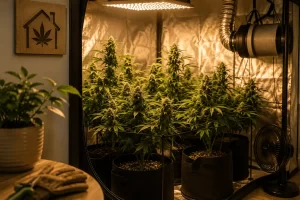
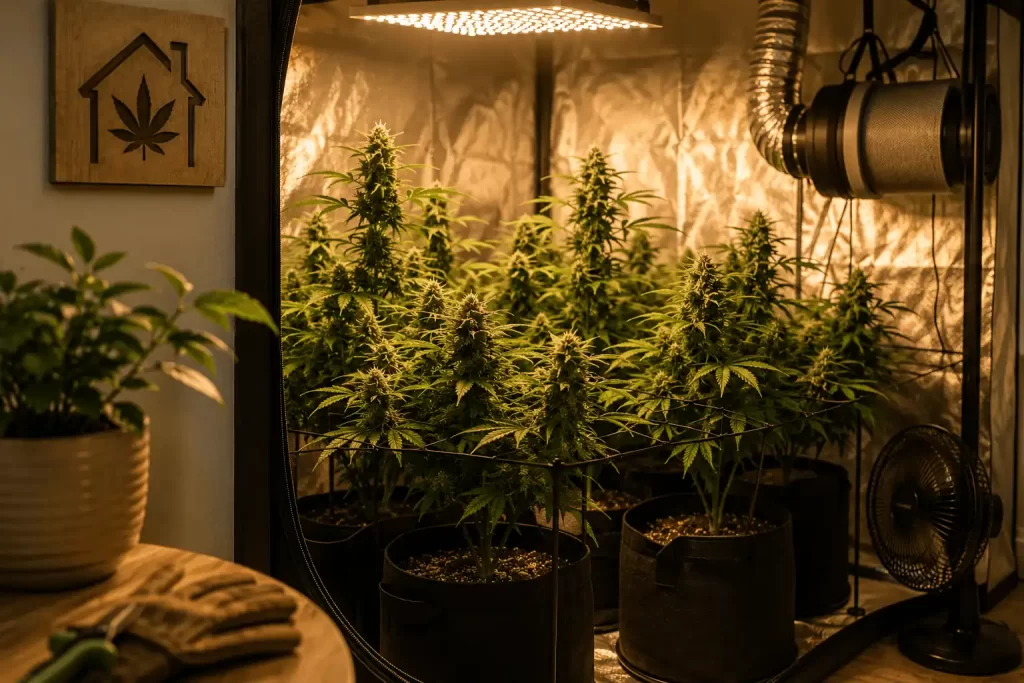
- Critical Catch: Any structure used for indoor cultivation in Santa Rosa, including garages and greenhouses, must be equipped with legal odor control filtration systems so that cannabis cannot be detected from outside the property.
Cultivating at Home: Navigating Santa Rosa Home Grow Laws
Proposition 64 opened the door for every adult in California to grow cannabis at home. But the state law doesn’t tell the whole story; it hands significant rule-making authority to individual cities and counties, who can layer their own conditions, restrictions, and enforcement mechanisms on top of the statewide baseline.
If you live in Santa Rosa and you want to enjoy growing weed at home in Santa Rosa without accidentally walking into a zoning violation or a neighbor complaint, you need to know the city’s specific rules, not just the state’s.
Santa Rosa’s homegrown laws are more detailed than many residents realize. The city’s Zoning Code lays out precise plant counts, location restrictions, structural requirements, and odor management standards that apply regardless of your medical status or household size. This guide walks through all of it, clearly and accurately, so you can grow with confidence.
The Legal Cannabis Plant Limit in Santa Rosa
Under Santa Rosa home grow laws, the maximum number of mature plants any single primary residence may cultivate is 6. The maximum limit is six mature plants per primary residence, and this maximum is to be maintained regardless of the number of residents, the reason for the cultivation (medical or adult use, personal or caregiver), and the presence of an accessory or junior accessory dwelling unit.
That last point catches many multi-generational households and ADU owners off guard. The personal cultivation of medical and/or adult use cannabis is limited to no more than six mature plants per primary residence, regardless of the number of residents and regardless of the presence of an accessory or junior accessory dwelling unit.
If four adults live together, they collectively share a 6-plant cap, not 6 per person. If your property has an attached granny flat or a detached ADU, the dwelling next door doesn’t open a second allotment. The cap is per residence, not per resident.
Cultivation of cannabis for personal use may occur only on parcels with an existing legal residence occupied by a full-time resident responsible for the cultivation. Short-term rentals, vacant properties, or parcels without a full-time occupant cannot legally host a personal grow under the city code.
The Indoor vs. Outdoor Split Rule
The legal cannabis plant limit in Santa Rosa allows up to 6 mature plants indoors, but outdoor grows are strictly capped at 2 mature plants and come with their own set of siting restrictions. Outdoor cultivation is limited to no more than two mature plants. Plants shall not be located in a front or street-side yard, unless fully screened from public view.
“Fully screened” means exactly that. No visible markers or evidence indicating that cannabis is being cultivated on the site shall be visible from the public right-of-way at street level, or from school property. A garden stake with a visible label, plants peeking above a fence line, or foliage visible from the sidewalk all constitute violations under this standard.
Location matters as much as visibility. Outdoor cultivation for personal use is prohibited on parcels located adjacent to a school property, as defined by Health and Safety Code Section 11362.768.
Security is also a hard requirement. All enclosures and structures used for cannabis cultivation shall have security measures sufficient to prevent access by children or other unauthorized persons. Whether that’s a locked gate, a secured greenhouse, or a fenced area with a latching mechanism, the standard is unauthorized access prevention, not just basic fencing.
City Rules vs. Sonoma County Personal Grow Limits
Where you live within the greater Sonoma County area determines which set of rules applies to your grow, and the difference between being inside Santa Rosa city limits and living in unincorporated county territory is significant.
Santa Rosa is an incorporated city with its own zoning code. If your address falls within city limits, Zoning Code Section 20-46.030 governs your grow. If your address sits outside the city boundary in unincorporated Sonoma Count think rural areas along Sonoma Highway, the Bennett Valley corridor, or other county-administered parcels, the Sonoma County Cannabis Program’s rules apply instead.
Here’s exactly how the two frameworks compare:
| Metric | City of Santa Rosa Limits | Unincorporated Sonoma County Limits |
| Max Plant Count (Adult-Use) | 6 mature plants per residence | Up to 6 plants within the 100 sq ft canopy limit |
| Max Plant Count (Medicinal) | 6 mature plants per residence (same cap applies) | Up to 100 sq ft canopy area per residence — no separate plant number cap for medical |
| Outdoor Cultivation Limits | Max 2 mature plants; not in front/side yard; fully screened from public view | Not permitted in front/side yard setbacks; prohibited in multi-family or R2/R3 zones; must be invisible from public right-of-way |
| Space / Canopy Restrictions | No square footage cap stated; 6-plant hard ceiling applies | 100 sq ft maximum canopy area per residence for all personal cultivation |
| Indoor Cultivation Structure | Must be a legally permitted structure with odor control | Must be in an enclosed accessory structure, greenhouse, or garage — not within the main residential structure unless no feasible alternative |
| Permit Required? | No permit required for personal cultivation | No permit is required for personal cultivation for medical use up to 100 square feet of grow area per residence or for non-medical use, no more than 6 plants |
The most important distinction in the Sonoma County personal grow limits framework is the canopy-area approach for medical grows. Cultivation of cannabis for personal use is limited to no more than one hundred square feet per residence, of which up to six plants can be cultivated for adult use purposes.
Indoor structure rules also differ. Indoor and mixed light personal cultivation must be contained within an enclosed accessory structure, greenhouse, or garage. Cultivation within a structure approved for residential use, as outlined in Chapter 7 of the county code, is prohibited unless there is no other feasible alternative location.
If you’re unsure which jurisdiction you fall under, the fastest way to check is the Sonoma County Parcel Viewer at sonomacounty.gov, which lets you confirm your parcel’s zoning designation and incorporated city status in under a minute.
Best Practices for Growing Weed at Home in Santa Rosa
Understanding the rules is step one. The second step is making sure your setup actually meets them because the most common enforcement trigger for home growers in Santa Rosa isn’t plant count violations. It’s odor complaints.
The city’s code is specific about what compliant indoor grows require, and meeting those standards is the clearest path to keeping your grow off the city’s radar for all the right reasons.
Mandatory Odor Control and Filtration
Under Santa Rosa home grow laws, any structure used for personal cannabis cultivation must be equipped with odor control filtration and ventilation systems so that the smell of cannabis cannot be detected outside the structure, under no exceptions. All structures used for cultivation shall be equipped with odor control filtration and ventilation systems such that the odors of cannabis cannot be detected from outside of the structure.
This requirement applies to every structure used for growing, not just dedicated grow rooms. If you’re growing in a garage, greenhouse, shed, or enclosed outbuilding, that structure needs compliant odor mitigation.
Carbon filters are the standard-of-care solution and the most widely used technology for meeting this requirement. A properly sized activated carbon filter matched to the cubic footage of your grow space and paired with an inline exhaust fan pulling air through the filter before it exits the structure is what most compliant residential growers in Santa Rosa use. The filter must be sized correctly for your space; an undersized filter will still allow detectable odor to escape, and the “cannot be detected from outside the structure” standard is the legal benchmark, not a best-effort guideline.
Replacement schedules matter too. Carbon filters typically need replacing every 12 to 18 months under regular use, and sooner during heavy flowering cycles when terpene output peaks. A carbon filter that worked when you installed it may no longer meet the legal standard 18 months later without maintenance.
Lighting, Power, and Ventilation Guardrails
Santa Rosa’s cultivation code addresses light pollution and noise, not just odor, meaning your lighting setup and ventilation equipment choices carry compliance weight beyond just plant health. Interior and exterior lighting shall utilize best management practices and technologies for reducing glare, light pollution, and light trespass onto adjacent properties.
For indoor grows, this primarily means window shielding. If your grow space has windows, light-proofing those windows is not just a cultivation best practice; it’s a code requirement. Blackout curtains, opaque film, or fully sealed light-blocking panels are the practical solutions. A room that glows at 2 am from grow lights visible through gaps in window coverings is a neighbor complaint and a code violation waiting to happen.
For ventilation, the city’s code prohibits noisy commercial generators as power sources for residential growth. If your setup requires significant additional electrical capacity, the correct path is a permitted electrical upgrade through a licensed electrician, not a portable generator. All structures used for Personal Cannabis Cultivation (including accessory structures, greenhouses, and garages) must be legally constructed with all applicable Building and Fire permits (including grading, building, electrical, mechanical, and plumbing) and shall adhere to the development standards within the base zone.
That last point is worth emphasizing for anyone planning to convert an existing structure. A garage or accessory building that wasn’t originally permitted for electrical upgrades needs those permits pulled before it legally qualifies as a compliant grow space under Santa Rosa home grow laws.
One additional safety prohibition worth knowing: The manufacture of cannabis products for personal non-commercial consumption shall be limited to solvent-free processes, or those that employ only non-flammable, nontoxic solvents that are recognized as safe pursuant to the Federal Food, Drug, and Cosmetic Act. The use of volatile solvents to manufacture cannabis products for personal consumption is prohibited. Butane, propane, and similar extraction methods are explicitly prohibited at the residential level.
Also read: How to Trim Cannabis Properly
Frequently Asked Questions
Can my landlord stop me from growing cannabis indoors in Santa Rosa?
Yes — your landlord has the full legal right to prohibit cannabis cultivation on their property through your lease agreement, and that lease provision takes precedence over state-level legalization. California’s Proposition 64 grants adults the right to cultivate up to 6 plants, but it does not override private property rights or lease terms. If your lease prohibits cannabis cultivation or if your landlord has not explicitly permitted it in writing, growing indoors puts you at risk of lease termination. Renters in Santa Rosa who want to grow should secure written authorization from their landlord before setting up any cultivation. Medical patients are not exempt from this requirement. Your right to possess and use cannabis is protected; your landlord’s right to control what happens on their property is equally protected.
What happens if someone exceeds the legal cannabis plant limit in Santa Rosa?
Exceeding the 6-plant limit under Santa Rosa home grow laws is a civil violation that can result in enforcement action by the city’s Code Enforcement Division, including mandatory removal of plants, civil fines, and potential referral for further action if violations are repeated or egregious. Under Zoning Code Section 20-46.030, personal cultivation that exceeds city standards, whether through plant count, location, lack of odor control, or unpermitted structures, is a code violation. A first complaint typically triggers an inspection and a written notice of violation with a deadline for correction. Continued non-compliance escalates to civil penalties. Growing more than the state’s 6-plant maximum (which applies uniformly across California) elevates the situation to potential criminal exposure under California Health and Safety Code, not just a local zoning matter.
Are greenhouses or detached garages counted as indoor or outdoor grows under the city code?
Greenhouses and detached garages are classified as indoor or mixed-light cultivation structures under Santa Rosa home grow laws, not outdoor grows, but they must meet the same permitting, odor control, and structural standards as any other cultivation structure. All structures used for Personal Cannabis Cultivation (including accessory structures, greenhouses, and garages) must be legally constructed with all applicable Building and Fire permits (including grading, building, electrical, mechanical, and plumbing) and shall adhere to the development standards within the base zone. A greenhouse or garage that hasn’t been legally permitted, or that lacks compliant carbon filters and odor control systems, does not qualify as a legal cultivation structure regardless of what you’re growing inside it. If you’re planning to use an existing structure, verify its permit status with the City of Santa Rosa’s Permit Center before you begin.