
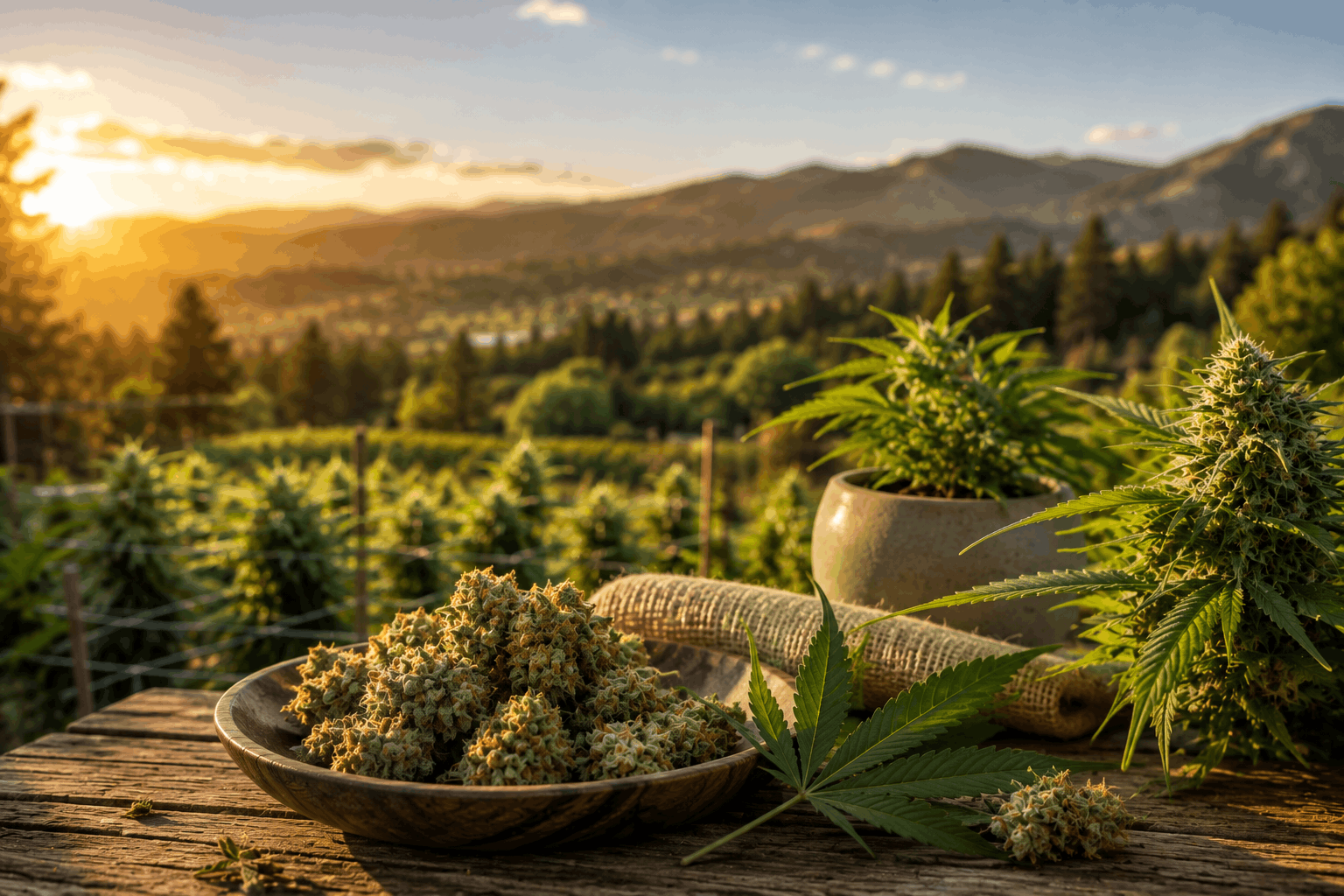
Cannabis Appellations California is the world's first legally protected, terroir-based origin standard for sun-grown cannabis — a regulatory framework that ties a product's name directly to the soil, climate, and cultivation history of a specific California landscape. Administered by the California Department of Food and Agriculture (CDFA) under Business and Professions Code (BPC) § 26063, the program converts geography itself into an enforceable, marketable asset for licensed outdoor cultivators.
1. Executive Summary: The California Cannabis Appellations Program (CAP) Matrix
The table below distinguishes the three regulatory tiers available to California cultivators under Cannabis Appellations California and related origin-labeling law.
|
Regulatory Tier |
Legal Basis |
Environmental Mandates |
Protection Level |
Primary California Cannabis Cultivation Regions |
|
Appellation of Origin (CAP) |
BPC § 26063; CCR Title 3, Div. 8, Ch. 2 |
100% full-sun, in-ground; no artificial light, greenhouses, hoop houses, or similar structures; specific soil, microclimate, cultivars, and historic practices required |
Highest — name is legally protected against misuse in advertising, labeling, and packaging |
Emerald Triangle, Sonoma County, Santa Cruz Mountains, Sierra Foothills |
|
County of Origin |
BPC § 26063(a) |
None beyond geographic sourcing |
Moderate — requires 100% of cannabis grown within the named county |
Any licensed cultivation county |
|
Standard Commercial License |
MAUCRSA general licensure |
None |
None — no origin-based label protection |
Statewide |
County of Origin vs. Appellation of Origin — the core legal distinction: a County of Origin designation only requires that the cannabis be grown entirely within the stated county's boundaries. A cannabis appellation of origin is a materially higher bar: it requires CDFA approval of a defined geographic boundary, documented soil composition and microclimate, specific cultivars, and historic cultivation practices unique to that place — the same logic that underlies wine AVAs, applied to sun-grown cannabis.
2. The Science of Cannabis Terroir California & SB 67 Standards
The Full-Sun, In-Ground Mandate
Senate Bill 67, signed by Governor Newsom on September 29, 2020, and championed by Senator Mike McGuire, is the statutory backbone restricting Cannabis Appellations California to outdoor, in-ground cultivation. SB 67 amended BPC § 26063 to explicitly exclude artificial lighting and structures — including greenhouses, hoop houses, glasshouses, conservatories, and hothouses — from qualifying for a cannabis appellation of origin. Practically, this means:
-
Plants must be rooted directly in native soil within the canopy area — container and raised-bed systems generally do not qualify.
-
No supplemental or artificial lighting may be used during flowering.
-
No structural coverings that alter natural sun exposure are permitted in flowering areas.
This mandate is the mechanism that makes cannabis terroir California scientifically meaningful: without it, indoor or light-deprivation greenhouse cultivation could claim regional identity without the environmental variables actually shaping the plant.
Environmental Fingerprinting
CDFA petition review evaluates the specific environmental signature of a proposed appellation, including:
-
Soil composition and native biome (mineral content, drainage, organic matter)
-
Microclimate variation — fog patterns, elevation, diurnal temperature swings
-
Native and heirloom cultivar lineage tied to the region's cultivation history
-
Documented historic growing practices specific to the proposed boundary
These factors are the working definition of cannabis terroir California under CAP: measurable environmental inputs that CDFA requires petitioners to document with scientific and historical evidence, not marketing language.
3. Key Regional Profiles & Case Studies
Cannabis Appellations Sonoma County
Sonoma County occupies a distinct position in the Cannabis Appellations California landscape because it already operates one of the country's most mature terroir-branding infrastructures: 19 federally recognized wine AVAs (American Viticultural Areas) covering everything from the fog-cooled West Sonoma Coast to the warmer Alexander Valley. Advocates — including Origins Council, which worked closely with Senator McGuire's office in drafting SB 67 — have pointed to this existing AVA framework as both a template and a competitive advantage for cannabis appellations Sonoma County petitioners: the county's coastal fog incursion through the Petaluma Gap and Russian River corridors, its diurnal temperature swings, and its varied elevation already provide the kind of documented microclimate diversity CDFA petition review looks for. Sonoma's decades of legacy small-farm cultivation, paired with a public accustomed to appellation-based purchasing (via wine), positions cannabis appellations Sonoma County proposals to draw directly on regional credibility that took the wine industry nearly 40 years to build.
The Emerald Triangle & Beyond
The Emerald Triangle — Humboldt and Mendocino counties — remains the symbolic and historical core of California cannabis cultivation regions, home to the legacy, hill-farming culture that originally drove the political push for appellations legislation. Beyond the Triangle, three additional California cannabis cultivation regions are actively positioning for appellation status:
-
Humboldt County — steep, remote hill terrain with decades of shade-and-sun-grown legacy cultivation and some of the earliest sub-regional mapping projects (e.g., Mendocino's own zone-based appellation groundwork).
-
Mendocino County — divided into distinct micro-regions with documented soil and climatic variation, with active grower-led appellation mapping initiatives.
-
Santa Cruz Mountains — coastal fog and mountain elevation combine for a cooler, high-diurnal-swing growing profile distinct from inland regions.
-
Sierra Foothills — higher elevation, drier climate, and volcanic/granitic soils differentiate this region from the coastal Emerald Triangle profile.
4. CDFA Petition & Approval Roadmap
Establishing a cannabis appellation of origin under Cannabis Appellations California follows a defined, evidence-heavy petition process administered by CDFA's Office of Agricultural Resilience and Sustainability (OARS):
-
Define geographic boundaries and historical evidence. Petitioners must delineate the proposed appellation using geographical features and provide documented evidence of historic cultivation activity within that boundary.
-
Document environmental features. Soil types, elevation, microclimate, and other distinguishing characteristics must be submitted as part of the petition record.
-
Prove legacy cultivation practices and specific cultivars. Petitioners must identify the standards, practices, and cultivars that will define authorized use of the appellation name going forward.
-
Submit fees and enter CDFA review. CDFA review includes a public comment period before a final decision is issued.
|
Petition Type |
Submission Fee |
Proposal Fee |
Total |
|
Establish an Appellation of Origin |
$2,850 |
$14,250 |
$17,100 |
|
Amend an Existing Appellation of Origin |
$1,425 |
$7,125 |
$8,550 |
2026 CDFA CAP rulemaking update: OARS advanced amendments in early 2026 that materially lower the barrier to entry for Cannabis Appellations California petitions. Most notably, the historic requirement that a petitioning organization include a minimum of three licensed cultivators has been proposed for repeal — allowing a single licensed cultivator to submit a petition, provided they cultivate within the proposed appellation's geographic area. The 2026 rulemaking also clarifies that appellation protections take effect 30 days after CDFA's final approval notice, giving existing users of a conflicting name a defined transition window, plus a one-year grace period for trademarks established in good faith before February 21, 2020.
Enforcement split: CDFA (via OARS) owns the petition approval process and defines what qualifies as a valid appellation of origin. Enforcement of misuse on retail packaging, labeling, and marketing — including unauthorized use of a protected appellation name — falls to the Department of Cannabis Control (DCC) under CCR Title 4, Division 19, labeling regulations. A brand can meet every CDFA cultivation standard and still face DCC enforcement action for a labeling violation unrelated to the growing practice itself.
Frequently Asked Questions
What is the California Cannabis Appellations Program (CAP)?
The California Cannabis Appellations Program is a CDFA-administered system, established under BPC § 26063, that lets licensed outdoor cultivators petition to register a geographic name — a cannabis appellation of origin — legally tied to specific soil, microclimate, cultivar, and cultivation-practice standards, similar to wine AVAs.
Can greenhouse cultivation qualify for a cannabis appellation of origin in California?
No. SB 67 strictly limits Cannabis Appellations in California to 100% full-sun, in-ground outdoor cultivation. Greenhouses, hoop houses, glasshouses, and any artificial lighting in flowering areas are explicitly excluded from qualifying for appellation status.
How do cannabis appellations Sonoma County compare to wine AVAs?
Cannabis appellations Sonoma County petitions follow the same CDFA framework as elsewhere in the state but can draw on Sonoma's existing 19 wine AVAs and decades of consumer familiarity with appellation-based origin claims, giving petitioners an established regional-branding foundation to build from.
Who enforces misuse of protected appellation names on retail packaging?
CDFA sets and approves the origin standards that define a valid cannabis appellation of origin. The Department of Cannabis Control (DCC) enforces compliance on retail packaging and labeling, addressing unauthorized or misleading use of a protected appellation name in the marketplace.
How much does it cost to petition for a California cannabis appellation of origin?
Establishing a new appellation costs $ 17,100 total (2,850 submission fee plus $14,250 proposal fee). Amending an existing appellation costs $ 8,550 total (1,425 submission fee plus $7,125 proposal fee), payable to CDFA during the petition review process.
As the 2026 CAP rulemaking moves toward single-cultivator eligibility, expect a wave of smaller, sub-regional petitions from legacy growing zones that previously couldn't meet the three-cultivator threshold — meaningfully expanding the map of Cannabis Appellations California beyond the first wave of Emerald Triangle and North Coast filings.