
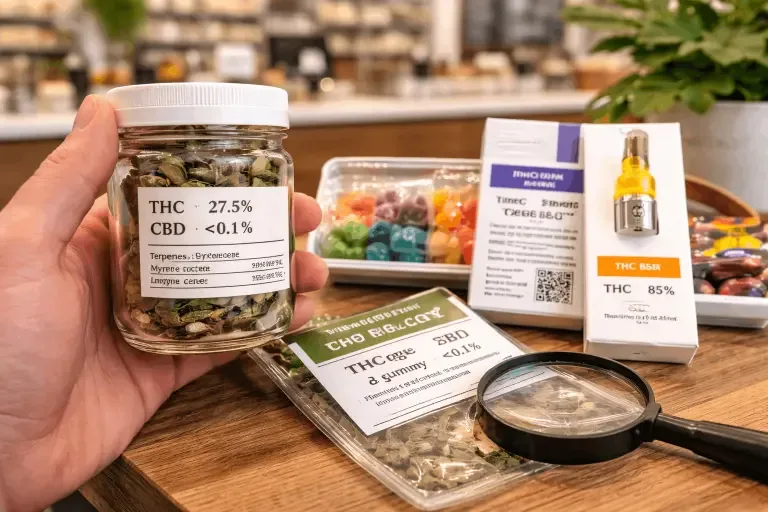
A well-designed marijuana packaging label should enable consumers to identify what they are purchasing and how potent the product is in one easy glance. If you are able to find the THC percentage, the CBD percentage, the serving size, and the batch/test information, you can avoid many of the mistakes that would otherwise occur when first trying an edible product. This article breaks down the marijuana packaging labels into their basic parts and provides simple guidelines for each component so that you can confidently select products that are appropriate for your individual needs.
What does a cannabis label guide help you understand in 30 seconds?
Think of your label like a nutrition label, but for cannabinoids. A basic cannabis label guide focuses on five things:
- Potency (THC and CBD)
- Serving size (especially for edibles)
- Cannabinoid form (like THC vs THCA on flower)
- Terpenes (aroma/flavor compounds that shape the vibe)
- Testing and traceability (batch number + COA)
If you’re new to understanding cannabis labels, your goal isn’t to memorize everything. It’s to learn which numbers matter most for your product type.
How to read a cannabis label without getting lost in the numbers?
Here’s the simple way to approach how to read a cannabis label: match the label to what you’re holding.
Flower and pre-rolls: percent is the main language
For flower, you’ll usually see a THC percentage (and sometimes a total THC value). That percentage helps you compare potency across strains and brands.
What to look for:
- THC percentage (often “Total THC”)
- CBD percentage (usually low in many THC-forward strains, but not always)
- Harvest/pack date (freshness matters)
- Batch/lot number (helps match the COA)
Quick tip: If two strains smell great and one is 18% THC and the other is 30% THC, the stronger one isn’t automatically “better.” It’s just stronger.
Edibles: milligrams per serving matter more than percent
For gummies, chocolates, drinks, and baked goods, the most important info is:
- mg THC per serving
- servings per package
- total mg THC in the package
- mg CBD (if included)
This is where people slip up. They eat “one piece” without realizing it’s two servings.
What does THC percentage actually mean for your experience?
A THC percentage is the amount of THC in the product by weight (common on flower). Higher THC often means stronger effects, but it’s not the full story. Your tolerance, how you consume, and even the terpene mix can change the experience.
Use these quick rules:
- If you’re cautious or new, consider staying in a moderate range and starting low.
- If you’re shopping for daytime use, ultra-high THC isn’t always the best match.
- If the label lists THCA, remember THCA converts to THC when heated (smoked/vaped). Some brands list both.
This is a key part of understanding cannabis labels because it keeps you from buying purely off a big number.
What does CBD percentage mean, and when should you care?
The CBD percentage tells you how much cannabidiol is in the product by weight (again, common for flower and some vapes). CBD is not intoxicating the same way THC is, but many people look for CBD to balance their experience or keep things smoother.
When to pay attention:
- You want a more mellow feel
- You’re sensitive to THC
- You’re shopping for a balanced product (THC + CBD)
On labels, the CBD percentage may be tiny on high-THC flower, but much higher on products made to be CBD-forward. If you’re trying to build a calmer experience, the CBD number matters.
How do terpenes on the label help you choose better?
Terpenes are aromatic compounds found in cannabis (and many plants). Labels sometimes list a terpene profile or “total terpenes.”
Common terpene names you may see:
- Myrcene (earthy)
- Limonene (citrus)
- Pinene (pine)
- Linalool (floral)
- Caryophyllene (peppery)
Here’s the practical way to use terpene info:
- Treat it like a flavor/aroma guide first.
- If you notice you like certain profiles (citrus, pine, earthy), terpenes help you repeat a good pick.
- Don’t treat terpene claims like medical promises. Use them as preference signals.
This is one of the easiest “level-ups” in a cannabis label guide because it helps you shop with more confidence than strain names alone.
What is serving size, and why does it matter so much for edibles?
Serving size is the difference between a comfortable night and a rough one.
Look for:
- Serving size (example: 1 gummy)
- Servings per package (example: 10)
- mg THC per serving (example: 5 mg)
- Total mg THC (example: 50 mg per package)
A beginner-friendly approach many budtenders recommend is “start low and go slow.” For edibles, this often means starting with a low dose, waiting a sufficient amount of time, and not stacking doses too soon. Effects can take longer than people expect.
How do you use the COA and batch number to confirm what’s inside?
A COA (certificate of analysis) is a lab report tied to a batch. Many products include a QR code you can scan to view them.
Match these:
- Batch/lot number on the package
- Batch/lot number on the COA
What to check on the COA:
- Cannabinoid results (THC, CBD)
- Terpene results (if provided)
- Safety screens (common categories include pesticides, heavy metals, microbes, residual solvents—depending on product type and local rules)
If the QR code doesn’t work, or the COA doesn’t match the batch number, that’s a fair reason to choose a different product.
This is another key part of how to read a cannabis label like someone who’s done it before.
Also read: Understanding THC vs CBD: What Santa Rosa Shoppers Should Know
Quick label-reading cheat sheet for each product type
| Product type | What matters most | Common label traps |
|---|---|---|
| Flower / pre-roll | THC percentage, pack date, terpene notes | Confusing THCA vs total THC |
| Edibles | mg per serving, servings per package | Eating multiple servings by accident |
| Vapes | mg or % cannabinoids, ingredients, batch/COA | Not noticing additives or total THC |
| Concentrates | potency + serving guidance | Assuming “a little” is always safe |
If you’re using this cannabis label guide while shopping, slow down for 15 seconds and confirm serving size before you pay.
Quick Answers: Cannabis Label Questions People Ask Every Day
- What’s the difference between THC percent and mg THC? THC percentage is common for flower. mg THC is common for edibles and tells you the dose per serving.
- How do I pick a safe edible serving size? Start with a low mg serving, wait long enough to feel effects, and avoid taking more too soon.
- Is a higher THC percentage always better? Not always. Higher THC percentage usually means stronger effects, but comfort depends on your tolerance and what you’re trying to feel.
- Do terpenes really matter? They’re most useful for flavor and repeatability. If you find a profile you like, it can help you shop more consistently.
- What should I check on the COA first? Match the batch number, then look at potency and basic safety results.
Last tip: once you learn the basics, labels stop feeling confusing and start feeling helpful. Use the serving size and cannabinoid numbers to guide your pace, and don’t be shy about asking questions in-store—teams like The Sweet Spot help people decode labels every day.